


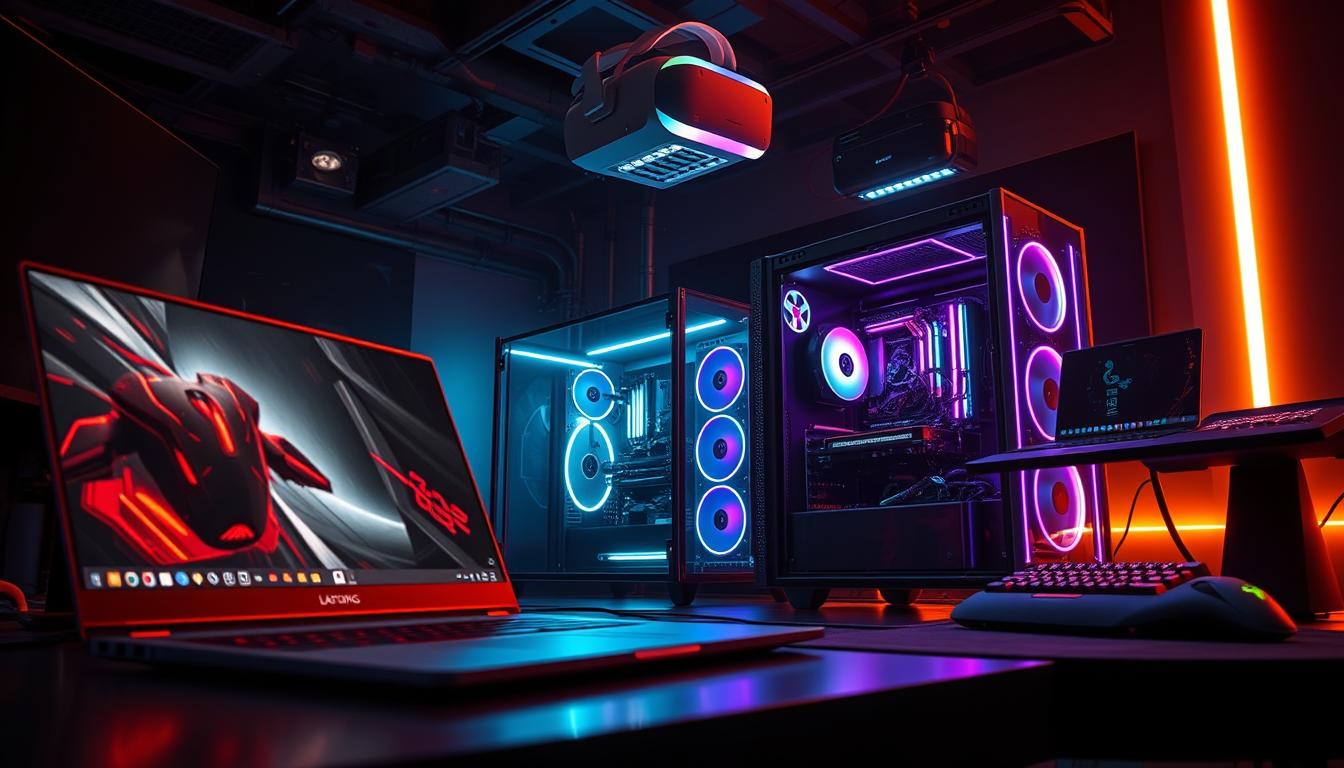

The debate between gaming laptops and desktops has been ongoing, with each having its own set of advantages. As we move into 2025, the gaming hardware landscape is evolving rapidly, driven by technological advancements and changing consumer preferences.
Gaming Laptops vs Desktops
In 2025, gamers will have more choices than ever, with both laptops and desktops offering high-performance capabilities. The key to making an informed decision lies in understanding the strengths and weaknesses of each platform.
Key Takeaways
- The gaming hardware market is witnessing significant advancements in 2025.
- Gaming laptops offer portability without compromising on performance.
- Desktops continue to provide superior customization options and upgradeability.
- Consumer preferences are shifting towards more powerful and efficient hardware.
- The choice between laptops and desktops depends on individual gaming needs and preferences.
The Current State of Gaming Hardware in 2025
As we step into 2025, the world of gaming hardware is witnessing significant transformations. The relentless pursuit of innovation has led to substantial advancements in gaming technology, changing the way we experience games.
Latest Technological Advancements
The latest technological advancements in gaming hardware are primarily driven by next-gen processors and GPUs. These components have become more powerful and efficient, enabling smoother gameplay and enhanced graphics.
Next-Gen Processors and GPUs
Next-generation processors and GPUs are designed to handle the demanding requirements of modern games. They offer improved performance, reduced power consumption, and enhanced features like ray tracing and AI-enhanced graphics.
DDR6 Memory and PCIe6.0 Storage
The adoption of DDR6 memory and PCIe6.0 storage has significantly improved data transfer speeds and overall system performance. This results in faster loading times and a more responsive gaming experience.
Market Trends and Consumer Preferences
The gaming hardware market is also influenced by shifting consumer preferences and emerging trends. Understanding these trends is crucial for gamers and manufacturers alike.
Shift in Gaming Platform Popularity
There is a noticeable shift in gaming platform popularity, with gamers increasingly opting for platforms that offer flexibility and high-performance capabilities.
Impact of Remote Work on Gaming Hardware Choices
The rise of remote work has impacted gaming hardware choices, with many gamers seeking hardware that can serve both work and play purposes efficiently.

gaming hardware advancements
Gaming Laptops vs Desktops: A Comprehensive Comparison
In 2025, the gaming landscape is more diverse than ever, with both laptops and desktops offering compelling advantages. The choice between these two platforms depends on several factors, including form factor, performance, and specific gaming needs.
Key Differences at a Glance
The primary distinctions between gaming laptops and desktops lie in their design and performance capabilities. Form factor and design evolution have led to laptops that are not only thinner and lighter but also more powerful.
Form Factor and Design Evolution
Gaming laptops have evolved significantly, with manufacturers incorporating advanced cooling systems and sleek designs that appeal to gamers on the go. This evolution has made laptops a viable option for those who need both power and portability.
Performance Expectations in 2025
In terms of performance, desktops generally offer more power for the same price compared to laptops. However, performance expectations in 2025 are being met by both platforms, with laptops closing the gap in terms of raw processing power.
How Gaming Has Evolved for Both Platforms
The gaming experience has undergone significant changes for both laptops and desktops, driven by technological convergence and platform-specific innovations. Laptops now offer desktop-like experiences, while desktops continue to push the boundaries of what’s possible in gaming.
Technological Convergence
Technological advancements have led to a convergence of sorts, where laptops are becoming more powerful and desktops are becoming more energy-efficient. This convergence is changing how gamers choose between the two platforms.
Platform-Specific Gaming Innovations
Both platforms have seen innovations that cater specifically to their strengths. For laptops, this means better battery life and more compact designs, while desktops continue to offer upgradeability and customization options.
Performance Analysis: Raw Power Comparison
The performance analysis of gaming laptops versus desktops is crucial in understanding which platform reigns supreme in 2025. To make an informed decision, it’s essential to compare their raw power.
CPU Performance Benchmarks
CPU performance is a critical factor in gaming. Desktop processors generally offer superior performance due to their ability to accommodate more powerful and heat-efficient designs.
Desktop vs Mobile Processors in AAA Gaming
In AAA gaming, desktop processors like AMD Ryzen 9 7950X and Intel Core i9-13900K outperform their mobile counterparts due to higher clock speeds and more cores. For instance, the AMD Ryzen 9 7950X offers 16 cores and 32 threads, significantly enhancing multitasking and gaming performance.
GPU Capabilities and Limitations
GPU capabilities play a pivotal role in gaming performance. While desktop GPUs offer more power, mobile GPUs have become increasingly capable.
Desktop GPUs vs Mobile GPUs in 2025
In 2025, desktop GPUs like NVIDIA GeForce RTX 4090 and AMD Radeon RX 7900 XTX continue to outperform mobile GPUs. However, mobile GPUs such as NVIDIA GeForce RTX 3080 Ti Laptop GPU have narrowed the gap, offering impressive performance for their size.
RAM and Storage Considerations
Adequate RAM and storage are vital for smooth gaming. Desktops generally offer easier upgrade options.
Impact on Load Times and Game Performance
Faster storage solutions like NVMe SSDs significantly reduce load times. For example, a desktop equipped with an NVMe SSD can load games much faster than a laptop with a slower storage solution. Additionally, having sufficient RAM ensures that games run smoothly without stuttering.
| Component | Gaming Laptops | Gaming Desktops |
| CPU | Up to 14 cores (e.g., AMD Ryzen 9 7940HS) | Up to 32 cores (e.g., AMD Ryzen 9 7950X) |
| GPU | NVIDIA GeForce RTX 3080 Ti Laptop GPU | NVIDIA GeForce RTX 4090 |
| RAM | Up to 64GB DDR5 | Up to 128GB DDR5 |
| Storage | Up to 4TB SSD | Up to 8TB SSD + HDD combinations |
As seen in the table, desktops have a significant advantage in terms of raw power and upgradability. However, laptops have made significant strides in closing the performance gap.
“The advancements in mobile hardware have been phenomenal, but desktops still hold the crown when it comes to raw gaming performance.” –
Tech Expert, 2025
Portability vs Power: The Fundamental Tradeoff
In the world of gaming hardware, the decision between laptops and desktops hinges on a crucial balance between portability and processing power. This tradeoff is at the heart of the debate between gaming laptops and desktops, each offering unique advantages and disadvantages.
The Value of Mobility in Modern Gaming
The value of mobility in modern gaming cannot be overstated. With the advancement of technology, gaming laptops have become increasingly capable of delivering high-quality gaming experiences on the go.
Gaming on the Go: Real-world Scenarios
Gaming on the go is no longer a novelty but a reality for many gamers. Whether it’s traveling, attending LAN parties, or simply moving between rooms, the ability to game without being tethered to a desk is highly valued.
- Gaming during travel
- Participating in LAN events
- Flexibility in home gaming setups
Space Considerations and Setup Requirements
On the other hand, desktop gaming setups require more space and have specific setup requirements, including a dedicated area for the computer, monitor, and peripherals.
Minimalist Gaming Setups vs Full Battlestations
The contrast between minimalist gaming setups and full battlestations highlights the different approaches gamers take. While some prefer a clutter-free environment, others enjoy the immersive experience of a fully equipped gaming station.
| Feature | Gaming Laptops | Desktop Gaming PCs |
| Portability | High | Low |
| Performance | Variable | High |
| Space Requirements | Minimal | Significant |
Price-to-Performance Ratio in 2025
In 2025, gamers are faced with a myriad of choices, and understanding the price-to-performance ratio is key to making an informed decision. The gaming hardware market has evolved significantly, offering a range of options from budget-friendly entry-level devices to high-end gaming rigs.
Entry-Level Gaming Options ($800-1200 Range)
Entry-level gaming options in the $800-1200 range have seen significant improvements. Gamers can expect decent performance from both laptops and desktops in this bracket. For instance, laptops with NVIDIA GeForce GTX 1660 Ti and AMD Ryzen 5 processors offer smooth gaming experiences at medium settings.
What You Can Expect for Your Money
In this range, you can expect to play modern games at 1080p resolution with medium to high graphics settings. Upgrade options like additional RAM or storage can further enhance performance.
Mid-Range Gaming Setups ($1200-2000 Range)
Mid-range gaming setups offer a noticeable jump in performance. Devices in this range often feature NVIDIA GeForce RTX 3060 or AMD Radeon RX 6700M graphics cards, providing higher frame rates and better graphics quality.
Best Value Propositions
Mid-range options are considered the best value for many gamers, as they offer a balance between performance and price. Quotes like, “The best value in gaming hardware often lies in the mid-range, where price and performance meet,” highlight this sweet spot.
High-End Gaming Experiences ($2000+ Range)
High-end gaming experiences come with a premium price tag. These systems are equipped with top-of-the-line components like NVIDIA GeForce RTX 3080 Ti and AMD Ryzen 9 processors, offering unparalleled gaming performance.
Diminishing Returns Analysis
While high-end gaming rigs offer superior performance, the law of diminishing returns applies. The incremental cost for marginal performance gains can be substantial. As noted by industry experts, “At the high end, the cost per frame per second increases significantly, making it less economical for some users.”
Upgradeability and Future-Proofing
In the ever-evolving gaming landscape, the ability to upgrade and future-proof your hardware is paramount. As new technologies emerge, gamers need to ensure their systems can adapt to the latest advancements.
Component Replacement Options for Desktops
Desktop gaming systems offer significant advantages when it comes to component replacement. Users can easily swap out outdated components for newer models, extending the life of their system. This modularity is a key benefit for desktop gamers.
Modular Design Benefits
The modular design of desktops allows for greater flexibility. Gamers can upgrade their GPU, RAM, or CPU as needed, without having to replace the entire system. This not only saves money but also reduces electronic waste.
| Component | Upgrade Options | Benefits |
| GPU | Upgrade to newer GPU models | Improved performance, support for new technologies |
| RAM | Add more RAM or upgrade to faster modules | Better multitasking, improved overall system performance |
| CPU | Upgrade to newer CPU models | Improved processing power, enhanced gaming experience |
Upgrade Limitations for Gaming Laptops
Gaming laptops, while highly portable, have significant limitations when it comes to upgrades. Most laptops have limited access to internal components, making upgrades challenging.
External GPU Solutions and Docking Options
One potential solution for laptop gamers is the use of external GPU (eGPU) solutions. eGPUs can provide a significant boost to graphics performance, though they may require additional investment and can be cumbersome to set up.
In conclusion, while desktops offer greater flexibility in terms of upgradeability, laptops are not without their options. Gamers must weigh the benefits and limitations of each when deciding on their gaming platform.
Power Consumption and Battery Life
In the gaming world, the energy efficiency of laptops and desktops is a significant consideration for both environmental and cost reasons. As gamers choose between these options, understanding their power consumption and battery life becomes essential.
Energy Efficiency Comparisons
Gaming desktops generally consume more power than laptops due to their more powerful components. However, advancements in technology have led to more energy-efficient designs. For instance, the shift towards more efficient GPUs has significantly reduced power consumption without compromising performance.
Environmental and Cost Considerations
The environmental impact of gaming devices is a growing concern. More energy-efficient devices not only reduce electricity costs for gamers but also minimize their carbon footprint. A comparison of the average annual power consumption of gaming laptops and desktops reveals significant differences.
| Device Type | Average Power Consumption (Watts) | Annual Energy Cost ($) |
| Gaming Laptop | 150-250 | 50-100 |
| Gaming Desktop | 300-500 | 100-200 |
Real-world Battery Performance for Gaming Laptops
Gaming laptops offer the advantage of portability, but their battery life varies significantly based on usage. Intensive gaming can drain batteries quickly, often lasting between 2 and 4 hours on a single charge.
Gaming Without a Power Outlet
For gamers on the go, battery life is a critical factor. Some gaming laptops are designed with more power-efficient components to extend battery life, allowing for longer gaming sessions without needing a power outlet.
When choosing a gaming device, considering both power consumption and battery life is crucial. While desktops offer raw power, laptops provide flexibility. Understanding these factors helps gamers make informed decisions that balance performance with energy efficiency.
Display Technology and Gaming Experience
The gaming experience in 2025 is not just about raw processing power; display technology also plays a vital role. The type of display used can significantly enhance or detract from the overall gaming experience.
Built-in vs External Displays
Gaming laptops offer the convenience of built-in displays, but external monitors can provide a more immersive experience. The choice between the two often depends on personal preference and gaming setup.
OLED, Mini-LED, and Micro-LED in 2025
In 2025, display technologies such as OLED, Mini-LED, and Micro-LED will offer superior visuals. OLED provides excellent color accuracy and contrast, while Mini-LED and Micro-LED offer improved brightness and energy efficiency.
Resolution and Refresh Rate Considerations
The resolution and refresh rate of a display are critical for a smooth gaming experience. Higher resolutions like 4K offer detailed graphics, while higher refresh rates (up to 240Hz) provide smoother gameplay.
4K vs 1440p vs 1080p Gaming Performance
Different resolutions have varying performance requirements. 4K gaming demands more powerful hardware compared to 1080p or 1440p. Gamers must balance their hardware capabilities with their display’s resolution.
Multi-Monitor Setups
Using multiple monitors can enhance productivity and immersion in gaming. A multi-monitor setup allows for a wider field of view and can be particularly beneficial for simulation games or professional applications.
Productivity and Immersion Benefits
Multi-monitor setups not only improve gaming immersion but also boost productivity. Professionals can have multiple applications open simultaneously, enhancing workflow efficiency.
| Display Technology | Resolution | Refresh Rate | Gaming Experience |
| OLED | 4K | 120Hz | Excellent color accuracy and smooth gameplay |
| Mini-LED | 1440p | 240Hz | High brightness and fast response time |
| Micro-LED | 1080p | 144Hz | Energy efficient with good color reproduction |
Gaming Ecosystem and Peripherals
As gaming technology advances, the importance of a robust gaming ecosystem and compatible peripherals cannot be overstated. The modern gaming experience is not just about the hardware; it’s also about how well different components work together.
Connectivity Options
The way we connect our peripherals has a significant impact on our gaming experience. New technologies like Thunderbolt 5 and USB 4.0 are revolutionizing the way we interact with our devices.
Thunderbolt 5 and USB 4.0 Impact
Thunderbolt 5 offers speeds of up to 80 Gbps, doubling the bandwidth of its predecessor. This means faster data transfer and the ability to support more demanding peripherals. USB 4.0, on the other hand, provides a more universal connection standard, ensuring compatibility across a wide range of devices. As noted by industry experts, “The advent of Thunderbolt 5 and USB 4.0 will significantly enhance the gaming experience by providing faster and more reliable connections.”
Peripheral Compatibility and Experience
The compatibility of peripherals with gaming platforms is crucial. Gamers need to ensure that their peripherals are optimized for their gaming setup, whether it’s a laptop or desktop.
Customization Options for Different Platforms
Different gaming platforms offer various customization options. For instance, desktops allow for more hardware customization compared to laptops. However, some gaming laptops offer advanced software customization options to enhance the gaming experience. As a gamer, being able to customize your peripherals to fit your gaming style is essential.
In conclusion, the gaming ecosystem and peripherals play a vital role in the overall gaming experience. With advancements in connectivity options and peripheral compatibility, gamers can enjoy a more immersive and personalized experience.
Ideal Use Cases: Who Should Choose What
When deciding between a gaming laptop and a desktop, the ideal choice depends on your specific gaming needs and preferences. Both options have their unique advantages and cater to different types of users.
Best Scenarios for Gaming Laptops
Gaming laptops are perfect for those who value portability and convenience. They are ideal for:
For Competitive Gamers
Competitive gamers who need to travel for tournaments or events will benefit from the portability of gaming laptops. As noted by a professional gamer, “The ability to game anywhere, anytime, is a game-changer.”
For Casual and Social Gamers
Casual and social gamers who enjoy gaming with friends at different locations will also appreciate the flexibility offered by gaming laptops.
When Desktop Gaming Makes More Sense
Desktop gaming, on the other hand, is more suited for those who prioritize raw power and upgradeability. This includes:
For Content Creators Who Game
Content creators who game can benefit from the superior processing power and easier upgrade options available with desktops, enhancing their overall productivity and gaming experience.
For Simulation and VR Enthusiasts
Simulation and VR enthusiasts require high-performance hardware to ensure a seamless experience. Desktops can accommodate more powerful GPUs and other components necessary for these demanding applications.
In conclusion, the choice between a gaming laptop and a desktop depends on your specific needs, whether you’re a competitive gamer, a casual gamer, a content creator, or a simulation and VR enthusiast.
Conclusion: Making Your Decision in 2025
As we conclude our comparison of gaming laptops and desktops in 2025, it’s clear that both options have their strengths and weaknesses. The decision-making process ultimately comes down to your specific needs and preferences.
Gaming laptops offer unparalleled portability and convenience, making them ideal for those who need to game on the go. On the other hand, desktops provide raw power and upgradeability, making them the better choice for those seeking high-end gaming experiences.
When making your decision, consider factors such as performance requirements, budget, and personal preferences. By weighing these factors, you can make an informed choice that suits your gaming needs in 2025.
Whether you opt for a gaming laptop or desktop, the most important thing is to choose a system that meets your expectations and provides an enjoyable gaming experience.
FAQ
What are the key differences between gaming laptops and desktops in 2025?
The main differences lie in their design, performance, and upgradeability. Gaming laptops offer portability, while desktops provide raw power and customization options.
How do next-gen processors and GPUs impact gaming performance?
Next-gen processors and GPUs significantly enhance gaming performance, offering improved frame rates, faster load times, and enhanced overall gaming experiences.
What is the price-to-performance ratio for gaming laptops and desktops in 2025?
The price-to-performance ratio varies across different price ranges. Entry-level options ($800-1200) offer a good balance, while mid-range ($1200-2000) and high-end ($2000+) options provide increasingly better performance.
Can gaming laptops be upgraded, and if so, how?
Gaming laptops have limited upgrade options, but some models allow for RAM and storage upgrades. External GPU solutions and docking options are also available.
How do display technologies like OLED, Mini-LED, and Micro-LED impact the gaming experience?
These display technologies offer improved color accuracy, contrast, and response times, enhancing the overall gaming experience. OLED, in particular, is known for its excellent color reproduction and fast response time.
What are the best use cases for gaming laptops versus desktops?
Gaming laptops are ideal for competitive gamers, casual gamers, and those who need portability. Desktops are better suited for content creators, simulation enthusiasts, and VR enthusiasts who require raw power and customization options.
How do Thunderbolt 5 and USB4.0 impact gaming peripherals and connectivity?
Thunderbolt 5 and USB4.0 offer faster data transfer rates, improved connectivity, and enhanced peripheral compatibility, making them ideal for gaming setups.
What are the environmental and cost considerations for gaming hardware?
Gaming hardware can have a significant environmental impact due to energy consumption and e-waste. Gamers should consider energy-efficient options, and manufacturers should prioritize sustainable design and production practices.