


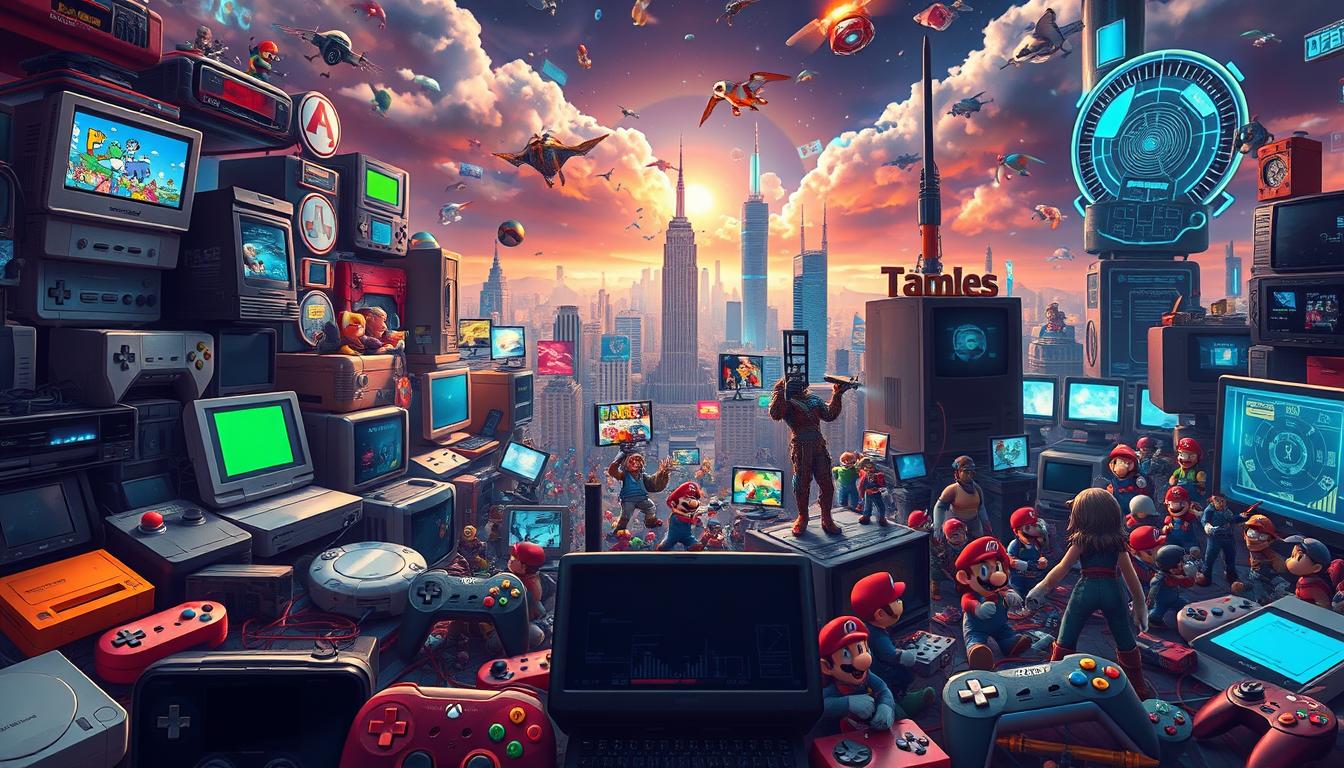

The world of video games has undergone a significant transformation since the iconic character Mario first appeared on the gaming scene.
From the early days of arcade games to the current era of immersive experiences, the history of video games is a story of innovation and technological advancements.
History of Video Games
The evolution has been remarkable, with the introduction of new characters, game genres, and now, the emerging concept of the metaverse, which promises to revolutionize the way we interact with virtual worlds.
Key Takeaways
- The history of video games spans several decades, from simple arcade games to complex virtual worlds.
- Iconic characters like Mario have played a significant role in shaping the industry.
- The metaverse represents a new frontier in gaming, offering immersive and interactive experiences.
- The evolution of video games is driven by technological advancements and innovation.
- The industry continues to grow, with new trends and technologies emerging regularly.
The Dawn of Gaming: Arcade Classics and Early Consoles
The dawn of gaming was marked by the introduction of arcade classics that captivated audiences worldwide. These pioneering games not only entertained but also laid the groundwork for the gaming industry’s future innovations.
Pong, Space Invaders, and the Arcade Revolution
The release of Pong in 1972 by Atari marked the beginning of the arcade revolution. This simple yet addictive game was the first commercially successful video game, paving the way for other classics like Space Invaders in 1978. Space Invaders, developed by Tomohiro Nishikado, became a cultural phenomenon, further establishing the popularity of arcade games.

arcade classics
Atari and the First Home Gaming Systems
Atari’s success in the arcades led to the development of the first home gaming systems. The Atari 2600, released in 1977, was one of the first commercially successful home consoles, bringing the arcade experience into living rooms. This innovation sparked a new era in gaming, making it possible for people to enjoy video games without visiting arcades.
| Console | Release Year | Notable Features |
| Atari 2600 | 1977 | First commercially successful home console, interchangeable cartridges |
| Pong | 1972 | First commercially successful video game, simple tennis-like gameplay |
| Space Invaders | 1978 | Cultural phenomenon, shooter gameplay, alien invasion theme |
Nintendo’s Golden Era: The Birth of Mario
With the introduction of the NES, Nintendo revolutionized the gaming industry. The NES brought high-quality video games into the living rooms of millions, setting a new standard for home consoles.
The Nintendo Entertainment System (NES) Revolution
The NES was more than just a console; it was a revival of the home video game market, which had suffered a significant crash in the early 1980s. Nintendo’s innovative design and robust library of games helped restore consumer confidence. The NES introduced the now-ubiquitous D-pad and brought arcade-quality gaming to the home.
Super Mario Bros: Creating a Gaming Icon
Super Mario Bros, released in 1985, was a launch title for the NES and became one of the best-selling video games of all time. It not only showcased the NES’s capabilities but also created a gaming icon in Mario. The game’s success was due to its tight gameplay, charming graphics, and the introduction of Mario’s brother, Luigi.
Other Nintendo Classics That Defined a Generation
Nintendo continued to innovate and captivate audiences with other classics such as The Legend of Zelda and Metroid. These games expanded the scope of what was possible in video games, offering deep storytelling and complex gameplay. The legacy of these titles continues to influence game development today.
The Great Console Wars: Sega vs. Nintendo
The console wars of the 1980s and 1990s were a pivotal moment in gaming history, marked by intense competition between Sega and Nintendo. This period was characterized by aggressive marketing, innovative technologies, and iconic characters that captivated gamers worldwide.
Sega Genesis and Sonic the Hedgehog
Sega entered the console market with the Sega Genesis, a 16-bit system that directly competed with Nintendo’s 8-bit NES. The release of Sonic the Hedgehog in 1991 was a game-changer, as this character’s speed and attitude provided a stark contrast to Nintendo’s Mario. Sonic became Sega’s mascot and a symbol of the brand’s challenge to Nintendo’s dominance.
Marketing Battles and Technological Competition
The competition between Sega and Nintendo was not limited to hardware and characters; it also extended to marketing and advertising. Sega’s “Genesis does what Nintendo doesn’t” campaign was a bold move, highlighting the perceived superiority of the Sega Genesis over the NES. Technologically, both companies pushed the boundaries, with Sega introducing innovative features like the Sega CD and 32X add-ons. Nintendo, on the other hand, focused on enhancing the gaming experience with the Super Nintendo Entertainment System (SNES), which featured improved graphics and gameplay.
The console wars ultimately drove innovation, benefiting gamers with better technology and more diverse gaming options. This era remains a significant chapter in the history of video games, showcasing the impact of competition on the industry’s growth.
The Comprehensive History of Video Games: A Timeline Perspective
The history of video games is a rich tapestry of innovation and entertainment. To understand this complex evolution, it’s essential to break down the key periods that have shaped the industry.
1970s-1980s: Foundation Years
The 1970s and 1980s laid the groundwork for the video game industry. This period saw the emergence of arcade classics like Pong and Space Invaders, as well as the introduction of early home consoles such as the Atari 2600. These foundational years were crucial in establishing the technical and creative foundations for future developments.
1990s: The 16-bit and 32-bit Revolution
The 1990s witnessed a significant leap forward with the advent of 16-bit and 32-bit consoles. This era was marked by intense competition between Sega and Nintendo, with iconic characters like Sonic the Hedgehog and Super Mario becoming household names. The 1990s also saw advancements in game design and storytelling, setting new standards for the industry.
2000s: Online Gaming and HD Graphics
The 2000s brought about a new era of online gaming and high-definition graphics. Consoles like the Xbox and PlayStation 2 enabled players to connect with others worldwide, while advancements in HD graphics provided a more immersive gaming experience. This period also saw the rise of digital distribution platforms, further transforming the gaming landscape.
3D Gaming Revolution: PlayStation and Beyond
The advent of 3D gaming brought about a new era of immersive gaming experiences. This revolution was spearheaded by two major players: Sony with its original PlayStation and Nintendo with the Nintendo 64.
Sony Enters the Game: The Original PlayStation
Sony’s entry into the gaming market with the original PlayStation in 1994 marked a significant milestone. The PlayStation was not just a console; it was a cultural phenomenon that brought 3D gaming to the mainstream. Its CD-ROM technology allowed for higher quality graphics and sound compared to cartridge-based systems.
Key Features of the Original PlayStation:
- CD-ROM technology for enhanced graphics and sound
- 3D graphics capabilities
- A vast library of games, including iconic titles like “Final Fantasy VII”
Nintendo64 and the 3D Platform Evolution
Nintendo responded to the PlayStation with the Nintendo64 (N64), released in 1996. The N64 was significant for its 3D graphics capabilities and innovative controller design, which included an analog stick for 3D control.
| Console | Release Year | Notable Features |
| PlayStation | 1994 | CD-ROM technology, 3D graphics |
| Nintendo64 | 1996 | 3D graphics, analog stick controller |
Both consoles played crucial roles in the evolution of 3D gaming, pushing the boundaries of what was possible in video games.
The Rise of Online Gaming Communities
The growth of online gaming communities has been a pivotal factor in the gaming industry’s development. As internet connectivity improved and technology advanced, gamers could finally connect with each other on a massive scale.
PC Gaming and Early MMORPGs
PC gaming played a crucial role in the evolution of online gaming. The emergence of MMORPGs (Massively Multiplayer Online Role-Playing Games) allowed thousands of players to interact within virtual worlds. These games laid the groundwork for complex online communities.
World of Warcraft and Massive Multiplayer Experiences
World of Warcraft, released in 2004, became a landmark title in the MMORPG genre. It offered an expansive world, intricate gameplay, and a strong focus on community, setting a new standard for multiplayer experiences.
Competitive Gaming and Early Esports
The rise of competitive gaming and esports transformed online communities into professional arenas. Tournaments and leagues began to form, with games like StarCraft and Counter-Strike leading the charge.
Xbox Live and Console Online Services
Microsoft’s Xbox Live service revolutionized console gaming by introducing robust online features. Launched in 2002, it provided a seamless experience for gamers, including matchmaking, voice chat, and achievements, setting a new benchmark for console online services.
The success of Xbox Live prompted other console manufacturers to develop their own online gaming networks, further expanding the reach of online gaming communities.
Mobile Gaming: Gaming in Your Pocket
The evolution of mobile gaming has transformed the way we play games, making it more accessible than ever. With the proliferation of smartphones, mobile devices have become a primary platform for gaming, offering a diverse range of experiences that cater to different demographics and preferences.
From Snake to Smartphone App Stores
Mobile gaming began with simple games like Snake on feature phones, but has evolved significantly with the advent of smartphones and app stores. The introduction of iOS and Android devices brought about a revolution, providing a platform for developers to create and distribute games globally.
The Casual Gaming Explosion
The accessibility of mobile devices led to a casual gaming explosion, attracting a new audience who were not traditional gamers. Games like Candy Crush Saga and Angry Birds became cultural phenomena, demonstrating the power of mobile gaming.
Free-to-Play and Microtransaction Models
The free-to-play model, coupled with microtransactions, has become a dominant business strategy in mobile gaming. This approach allows players to download and play games for free, with optional in-app purchases for virtual goods or currency.
Mobile Gaming’s Global Impact
Mobile gaming has had a significant global impact, not only in terms of revenue but also in shaping gaming culture. It has democratized access to gaming, enabling people from all over the world to participate.
| Year | Mobile Gaming Revenue (Billion USD) | Growth Rate (%) |
| 2018 | 45 | 13.4 |
| 2019 | 52 | 15.6 |
| 2020 | 63 | 21.2 |
The Indie Game Renaissance
The indie game scene has witnessed a significant renaissance over the past decade, driven by advancements in digital distribution and developer freedom. This resurgence has transformed the gaming landscape, enabling developers to create innovative and diverse gaming experiences.
Digital Distribution and Developer Freedom
Digital distribution platforms such as Steam, GOG, and the Epic Games Store have revolutionized the way indie games are published and consumed. These platforms provide developer freedom, allowing creators to bypass traditional publisher constraints and connect directly with their audience.
The ease of distribution has led to a proliferation of indie games across various genres, from narrative-driven adventures to innovative puzzle games. This shift has democratized game development, enabling new voices and ideas to emerge in the industry.
Landmark Indie Titles That Changed the Industry
Several indie games have made significant impacts on the industry, pushing boundaries and achieving widespread acclaim. Two notable examples are:
- Minecraft, which became a cultural phenomenon, was later acquired by Microsoft.
- Games that have showcased artistic innovation, such as “Cuphead” and “Hyper Light Drifter.”
Minecraft: From Indie Phenomenon to Microsoft Acquisition
Minecraft is a prime example of an indie game that achieved massive success. Created by Markus “Notch” Persson, it became a global phenomenon, appealing to a broad audience with its unique sandbox gameplay. The game’s success eventually led to its acquisition by Microsoft in 2014.
Artistic Innovation in Indie Development
Indie developers are known for their artistic innovation, often experimenting with new visual styles and gameplay mechanics. Titles like “Cuphead” and “Hyper Light Drifter” have received critical acclaim for their distinctive artistry and emotional depth.
| Game Title | Year Released | Notable Features |
| Minecraft | 2011 | Sandbox gameplay, blocky graphics |
| Cuphead | 2017 | Run-and-gun gameplay, hand-drawn animation |
| Hyper Light Drifter | 2016 | Top-down action, pixel art, emotional narrative |
Virtual Reality and Augmented Reality: New Dimensions
Virtual reality and augmented reality are revolutionizing the gaming landscape, offering immersive experiences like never before. These technologies are not just enhancing gameplay but are transforming the way we interact with virtual worlds.
Early VR Attempts and Modern Breakthroughs
The journey of VR in gaming began decades ago, but it wasn’t until recent years that significant breakthroughs were achieved. Early attempts were hampered by technological limitations, but modern advancements have made VR more accessible and affordable.
Oculus, Valve, and the VR Renaissance
Companies like Oculus and Valve have been at the forefront of the VR renaissance. Oculus, acquired by Facebook, has developed high-quality VR headsets like the Oculus Rift, while Valve’s Index offers advanced VR capabilities with high-resolution graphics and precise tracking.
VR Gaming Experiences and Innovations
VR gaming experiences range from immersive simulations to interactive stories. Innovations in controller design and haptic feedback are further enhancing the sense of presence in virtual environments. As VR technology continues to evolve, we can expect even more sophisticated gaming experiences.
AR Gaming: Pokémon GO and Beyond
Augmented reality gaming has seen a significant surge in popularity, thanks in part to the success of Pokémon GO. This game brought AR into the mainstream, encouraging players to explore their surroundings to catch Pokémon. Since then, other AR games have followed, offering unique gaming experiences that blend the physical and digital worlds.
As noted by a gaming industry expert, “AR has the potential to change the way we play games, making the real world a part of the game.” The future of AR gaming looks promising, with ongoing advancements in smartphone technology and the development of AR glasses.
Conclusion: From Mario to Metaverse – The Future of Gaming
The gaming industry has undergone a remarkable transformation since the introduction of iconic characters like Mario. From the early days of arcade classics and home consoles to the current era of virtual reality and the metaverse, gaming has evolved into a diverse and immersive entertainment medium.
The journey through the history of video games highlights significant milestones, including Nintendo’s golden era, the console wars between Sega and Nintendo, and the rise of online gaming communities. The advent of mobile gaming, the indie game renaissance, and advancements in virtual and augmented reality have further expanded the gaming landscape.
As the gaming industry continues to evolve, the concept of the metaverse is becoming increasingly prominent. The metaverse represents a future where gaming, social interaction, and virtual experiences converge, creating new opportunities for gamers and developers alike. The future of gaming is likely to be shaped by technological innovations, changing consumer behaviors, and the continued blurring of lines between the physical and virtual worlds.
The legacy of Mario and other gaming icons will continue to influence the industry, even as new technologies and platforms emerge. The future of gaming holds much promise, with the potential for more immersive, interactive, and connected experiences that will captivate audiences worldwide.
FAQ
What is the significance of Mario in the history of video games?
Mario is one of the most iconic characters in video games, created by Nintendo. He first appeared in the arcade game Donkey Kong in 1981 and later became the main character in the Super Mario Bros. series, which revolutionized the platformer genre and significantly contributed to Nintendo’s success.
What was the impact of the Sega Genesis on the gaming industry?
The Sega Genesis, released in 1988, was a key player in the console wars of the 1990s. It introduced Sonic the Hedgehog, a character who rivaled Nintendo’s Mario, and its success was driven by innovative marketing and a strong lineup of games, challenging Nintendo’s dominance.
How did the introduction of 3D gaming change the industry?
The transition to 3D gaming in the mid-1990s, led by consoles like the Sony PlayStation and Nintendo 64, marked a significant shift in game development, enabling more immersive experiences and changing the way games were designed and played.
What role did online gaming communities play in the evolution of gaming?
Online gaming communities, facilitated by services like Xbox Live and the growth of MMORPGs (Massively Multiplayer Online Role-Playing Games) such as World of Warcraft, have been crucial in shaping modern gaming, enabling global connectivity, and creating new forms of social interaction and competition.
How has mobile gaming influenced the gaming industry?
Mobile gaming has democratized access to games, making them available to a wider audience through smartphones. The rise of casual games, free-to-play models, and microtransactions has significantly impacted the industry’s business models and revenue streams.
What is the metaverse, and how might it affect gaming?
The metaverse refers to a shared, immersive, and interactive virtual world where users can create their own avatars and environments and engage with other users in real time. The concept of the metaverse has the potential to revolutionize gaming by providing a more immersive, interconnected, and dynamic gaming experience.
How have indie games contributed to the diversity of the gaming landscape?
Indie games have brought innovation, creativity, and diversity to the gaming industry. With the advent of digital distribution platforms, indie developers have been able to release games that often challenge traditional gaming norms, offering unique experiences and artistic expression.
What advancements have been made in virtual reality (VR) and augmented reality (AR) gaming?
VR and AR technologies have advanced significantly, with devices like Oculus Rift and HTC Vive offering immersive VR experiences, and games like Pokémon GO showcasing the potential of AR. These technologies continue to evolve, promising even more sophisticated gaming experiences.