


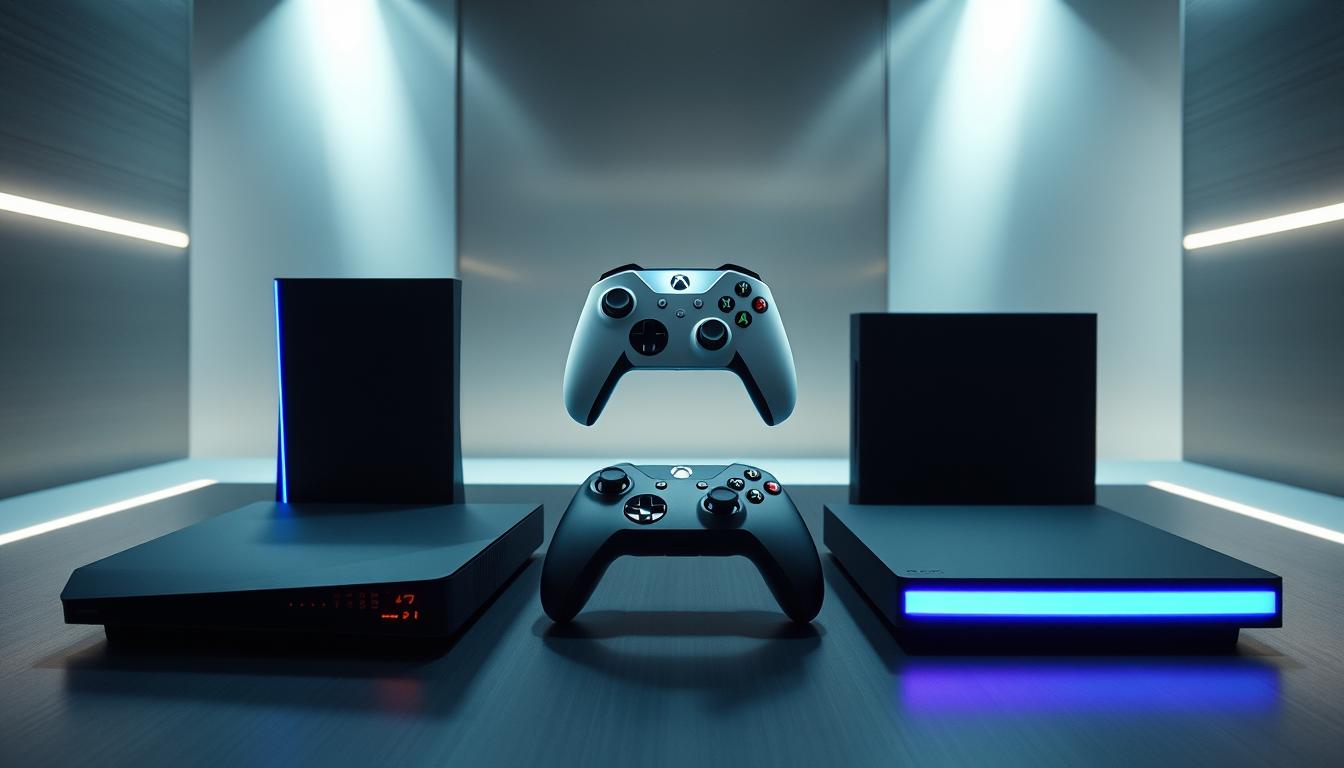

The gaming world is on the brink of a new era with the upcoming releases of next-generation consoles. The latest gaming console releases are set to revolutionize the industry with innovative features and enhanced gaming experiences.
PS6, Xbox Future & More
As gamers eagerly await the launch of PS6 and Xbox Future, the anticipation is building. These new consoles promise to deliver improved graphics, faster processing, and immersive gameplay, setting a new standard for the gaming community.
Key Takeaways
- Next-generation consoles are expected to revolutionize the gaming industry.
- PS6 and Xbox Future are among the most anticipated releases.
- Enhanced graphics and faster processing are key features of the new consoles.
- The gaming community is eagerly awaiting the launch of these new consoles.
- Innovative features and immersive gameplay are expected to set a new standard.
The Current Gaming Console Landscape
The modern gaming console market is led by three primary competitors: PlayStation5, Xbox Series X/S, and Nintendo Switch. These consoles have distinct features and capabilities that cater to different segments of the gaming community.
PlayStation 5 and Xbox Series X/S Performance
The PlayStation5 and Xbox Series X/S are at the forefront of console technology, offering high-performance processing and advanced graphics capabilities. The PlayStation5 boasts a powerful AMD Zen 2 CPU and a Radeon Navi GPU, enabling ray tracing and 8K resolution. Similarly, the Xbox Series X/S features a custom AMD processor and supports variable refresh rates and high dynamic range.

gaming console landscape
Nintendo Switch Dominance in the Handheld Market
The Nintendo Switch has carved out a unique niche in the gaming market with its hybrid design, allowing for both home console and portable handheld gaming experiences. Its versatility and exclusive titles like Super Mario Odyssey and The Legend of Zelda: Breath of the Wild have contributed to its significant market presence.
Market Share and Sales Figures
As of the latest reports, the market share is divided among the three major consoles, with the PlayStation5 holding a significant portion due to its strong lineup of exclusive games. The Nintendo Switch continues to be a top seller, driven by its family-friendly appeal and innovative design. The Xbox Series X/S, while trailing slightly, remains competitive due to its robust online gaming features and integration with the Xbox ecosystem.
- PlayStation 5: Leading in terms of processing power and exclusive titles.
- Nintendo Switch: Dominant in the handheld market with its unique hybrid design.
- Xbox Series X/S: Competitive with its advanced online features and ecosystem.
PlayStation 6: What We Know So Far
Sony’s next-generation console, the PlayStation6, is on the horizon, with various speculations about its features and release timeline. As the gaming community eagerly awaits more information, several rumors and leaks have surfaced, providing insight into what we can expect from the PS6.
Rumored Release Date and Development Status
The exact release date of the PlayStation6 remains under wraps, but industry insiders suggest it could hit the market by late 2026 or early 2027. Sony has not officially confirmed the release window, but the company is reportedly in the advanced stages of development.
Expected Hardware Specifications
The PlayStation6 is anticipated to be a significant leap forward in terms of hardware. Let’s delve into the expected specifications:
Processing Power and Graphics Capabilities
The PS6 is rumored to feature a more powerful CPU and GPU compared to its predecessor. The new console is expected to utilize an AMD Zen 4 CPU architecture and a next-generation RDNA 3 GPU, potentially offering a substantial boost in processing power and graphics rendering.
Storage Solutions and Memory
In terms of storage, the PlayStation6 is likely to adopt a high-speed SSD, potentially leveraging the latest PCIe 5.0 technology for faster load times and improved overall performance. The console is also expected to come with an increased amount of RAM, possibly 24 GB or more of GDDR7 memory, to handle the demands of next-generation games.
| Component | PS5 Specifications | Rumored PS6 Specifications |
| CPU | AMD Zen 2 | AMD Zen 4 |
| GPU | RDNA 2 | RDNA 3 |
| RAM | 16 GB GDDR6 | 24 GB GDDR7 |
| Storage | SSD (PCIe 4.0) | SSD (PCIe 5.0) |
Potential New Features and Innovations
Beyond the hardware upgrades, the PlayStation6 is expected to introduce several innovative features that could redefine the gaming experience.
Controller Advancements Beyond DualSense
The PS6 controller is rumored to include haptic feedback enhancements, potentially with more nuanced and responsive tactile experiences. Additionally, there could be improvements in battery life and possibly the introduction of new gesture-based controls.
PlayStation VR2 Integration
Sony is expected to further integrate its PlayStation VR2 technology with the PS6, offering more immersive VR experiences. This could include enhanced resolution, improved tracking, and a wider range of VR-compatible games.
As we await the official announcement from Sony, the anticipation for the PlayStation6 continues to build. With its promising hardware specifications and innovative features, the PS6 is poised to take the gaming world by storm.
Xbox Future: Microsoft’s Next-Generation Plans
As the gaming landscape continues to evolve, Microsoft’s upcoming Xbox Future is set to play a pivotal role in shaping the industry’s future. With significant advancements in technology and a strong focus on ecosystem integration, Xbox Future is anticipated to be a major player in the next-generation console market.
Project Timeline and Announcement Expectations
Microsoft is expected to make a formal announcement about the future of Xbox Future in the near future, with speculation suggesting a release date potentially in 2026 or 2027. The company has been tight-lipped about the exact timeline, but industry insiders have been leaking information about the console’s development progress.
Key Milestones:
- Technical specifications reveal
- Game lineup announcement
- Developer kits distribution
Rumored Technical Specifications
The technical specifications of Xbox Future have been a topic of much speculation. Rumors suggest that the console will feature a significant upgrade in processing power, potentially incorporating a custom AMD Zen 4 CPU and an RDNA 3 GPU.
Processing Architecture and Performance Targets
The processing architecture of Xbox Future is expected to be a major leap forward, with a focus on delivering high-performance processing and advanced graphics rendering capabilities. Microsoft aims to achieve performance targets that will set a new standard for the gaming industry.
Backward Compatibility Approach
Microsoft has historically placed a strong emphasis on backward compatibility, and Xbox Future is expected to continue this trend. The console is likely to support a wide range of previous Xbox games, enhancing its appeal to gamers with existing libraries.
Xbox Ecosystem Integration
Xbox Future will be deeply integrated with the Xbox ecosystem, including Game Pass and PC and mobile platforms. This integration is expected to enhance the gaming experience, offering users a seamless and versatile way to play games across different devices.
Game Pass Evolution
Game Pass has been a cornerstone of Microsoft’s gaming strategy, and Xbox Future will likely see further evolution of this service. Expectations include an expanded game library, improved cloud gaming capabilities, and potentially new features that enhance the overall value proposition of Game Pass.
PC and Mobile Connectivity
The integration of Xbox Future with PC and mobile platforms will be a key aspect of its appeal. Microsoft’s commitment to cross-platform play and cloud gaming will enable gamers to access their games and entertainment content from anywhere, on a variety of devices.
Nintendo’s Next Console Generation
As Nintendo continues to dominate the gaming industry, speculation about its next-generation console, potentially dubbed “Switch2,” has been rampant among gamers and tech enthusiasts alike. The anticipation is fueled by Nintendo’s history of innovative console designs and its ability to create engaging gaming experiences.
Switch2 Development and Rumors
Rumors surrounding the “Switch2” have been circulating, with various reports suggesting significant upgrades in hardware and potentially new features that could revolutionize gaming on the go. Nintendo’s commitment to innovation is expected to play a crucial role in the development of its next console.
Hardware Expectations and Form Factor
The “Switch2” is expected to boast improved hardware specifications, including a more powerful processor, enhanced graphics capabilities, and potentially new technologies such as ray tracing or artificial intelligence-enhanced gaming. The form factor is also a subject of speculation, with some rumors suggesting a more modular design or improvements to the Joy-Con controllers.
Release Window Predictions
While Nintendo has not officially announced a release date for the “Switch2,” industry insiders and analysts have made various predictions. The release window is speculated to be within the next two to three years, although Nintendo is known for its secrecy, making it difficult to predict with certainty.
Nintendo’s Unique Approach to Console Evolution
Nintendo’s approach to console development is distinct, focusing on innovative hardware and software integration that appeals to a broad audience, including families. The company’s commitment to creating unique gaming experiences that are both accessible and enjoyable for all ages is a key factor in its continued success.
Software-Hardware Integration Strategy
Nintendo’s strategy involves tightly integrating its hardware and software to create seamless gaming experiences. This approach is evident in the Switch’s ability to transition between handheld and docked modes, and it’s expected to be further enhanced in the “Switch2.”
Family-Friendly Gaming Focus
Nintendo has long been committed to creating gaming experiences that are enjoyable for all ages. The “Switch2” is expected to continue this tradition, with a focus on family-friendly gaming that includes a wide range of accessible titles and potentially new features that enhance multiplayer and social gaming experiences.
PS6, Xbox Future & More: Comparing Next-Gen Platforms
As we move towards the next generation of gaming, the comparison between PS6, Xbox Future, and other emerging consoles will be crucial for gamers. The next-gen platforms are expected to revolutionize the gaming industry with significant advancements in performance, exclusive games, and innovative features.
Performance Expectations and Benchmarks
The performance of next-gen consoles is a critical factor that will influence consumer choices. The PS6 is expected to feature a more powerful AMD Zen 2 CPU and a next-generation GPU, potentially offering a significant boost in graphics processing capabilities. Similarly, the Xbox Future is rumored to have enhanced hardware specifications, including a more efficient processor and advanced graphics rendering technology.
Benchmarks and Performance Metrics will play a crucial role in determining how these consoles stack up against each other. Gamers can expect to see improvements in frame rates, resolution, and overall gaming experience.
Exclusive Game Lineups and Studios
Exclusive game titles are a major draw for console gamers. The PS6 is likely to feature exclusive titles from renowned studios such as Naughty Dog and Insomniac Games, while the Xbox Future may boast exclusives from studios like Obsidian Entertainment and Turn 10 Studios.
- PS6 exclusives: The Last of Us sequel, God of War Ragnarök
- Xbox Future exclusives: Halo series, Forza series
Price Point Predictions and Value Propositions
The pricing strategy for next-gen consoles will be a key factor in their adoption. While exact prices are not yet known, industry trends suggest that the PS6 and Xbox Future will likely be priced competitively, potentially between $500-$600.
The value proposition of these consoles will depend on their performance, exclusive games, and additional features such as backward compatibility and cloud gaming capabilities. Gamers will need to weigh these factors when deciding which console to purchase.
| Console | Expected Price | Notable Features |
| PS6 | $499-$599 | Advanced GPU, Exclusive titles |
| Xbox Future | $499-$599 | Enhanced CPU, Xbox Ecosystem |
Cloud Gaming: The Console Alternative
The gaming landscape is shifting with the advent of cloud gaming, which allows players to enjoy high-performance games on various devices without the need for a dedicated console. This emerging technology is transforming the way we experience video games, offering a viable alternative to traditional console gaming.
NVIDIA GeForce NOW and Amazon Luna Updates
NVIDIA GeForce NOW has been at the forefront of cloud gaming, providing users with the ability to play high-quality games on a range of devices. Recent updates have enhanced the service, offering improved performance and a broader game library. Amazon Luna, another significant player in the cloud gaming space, has also made strides with its innovative approach to game streaming.
“Cloud gaming represents a significant shift in how we consume games, moving away from the need for powerful local hardware,” said a representative from NVIDIA. “Our focus is on delivering high-quality gaming experiences to a wide audience.”
Xbox Cloud Gaming Expansion
Xbox Cloud Gaming has been expanding its capabilities, integrating seamlessly with Microsoft’s ecosystem to provide a robust gaming experience. The service allows gamers to play high-quality games on various devices, leveraging the power of cloud computing.
- Enhanced game streaming quality
- Integration with the Xbox ecosystem
- Access to a wide range of games
PlayStation’s Cloud Strategy
PlayStation has also been developing its cloud gaming strategy, focusing on integrating cloud technology into its existing infrastructure. This approach aims to enhance the gaming experience for PlayStation users, offering greater flexibility and accessibility.
As cloud gaming continues to evolve, it’s clear that this technology is set to play a significant role in the future of gaming. By providing gamers with more choices and flexibility, cloud gaming services are poised to revolutionize the industry.
Emerging Console Technologies and Innovations
Emerging console technologies are not just about improving performance; they’re about creating new gaming experiences through innovations like VR and AI. The integration of these technologies is set to revolutionize the gaming industry, offering gamers more immersive, interactive, and personalized experiences.
Virtual Reality and Augmented Reality Integration
Virtual Reality (VR) and Augmented Reality (AR) are transforming the gaming landscape by providing immersive experiences that were previously unimaginable. Consoles are now being designed with VR and AR capabilities in mind, allowing for a more interactive and engaging gaming experience.
- Enhanced immersion through VR headsets
- Interactive gaming experiences with AR technology
- Potential for new game genres that utilize VR/AR
AI-Enhanced Gaming Experiences
Artificial Intelligence (AI) is being increasingly used to enhance gaming experiences, making games more dynamic and responsive to the player’s actions.
Procedural Content Generation
AI-driven procedural content generation allows for the creation of vast, diverse game worlds that can be explored by players, offering a unique experience each time they play.
Adaptive Difficulty and Personalization
AI also enables adaptive difficulty adjustment, ensuring that games are challenging yet enjoyable for players of all skill levels. This personalization enhances the overall gaming experience, keeping players engaged for longer.
Key benefits of AI in gaming:
- Increased replayability through procedural generation
- Personalized gaming experiences through adaptive difficulty
- More realistic NPC behaviors
Sustainability Initiatives in Console Manufacturing
As concern for the environment grows, console manufacturers are adopting sustainability initiatives to reduce their ecological footprint. This includes using eco-friendly materials, reducing energy consumption, and implementing recycling programs for old consoles.
- Eco-friendly packaging and materials
- Energy-efficient console designs
- Recycling initiatives for electronic waste
By embracing these emerging technologies and innovations, the gaming industry is poised to deliver more immersive, engaging, and sustainable gaming experiences in the future.
How Next-Gen Consoles Will Transform Gaming
As the gaming industry awaits the release of next-gen consoles, the potential for significant changes in game development and consumer behavior is vast. The introduction of new technologies and features is expected to revolutionize the gaming landscape.
Impact on Game Development and Design
The next-generation consoles will bring about a paradigm shift in game development and design. With enhanced hardware capabilities, developers will be able to create more complex and visually stunning games.
Cross-Platform Development Challenges
One of the significant challenges developers will face is cross-platform development. Ensuring seamless gameplay across different platforms will require significant investments in technology and infrastructure.
New Gameplay Possibilities
On the other hand, next-gen consoles will also enable new gameplay possibilities. Features like ray tracing, AI-driven NPCs, and advanced physics engines will create more immersive gaming experiences.
Consumer Behavior and Adoption Predictions
The release of next-gen consoles will also influence consumer behavior and adoption trends. As consumers upgrade to newer consoles, there will be a shift in how games are consumed and distributed.
Digital vs. Physical Media Trends
The trend towards digital distribution is expected to continue, with more consumers opting for digital copies of games over physical media. This shift will have significant implications for retailers and game publishers.
Subscription Model Growth
Subscription models are also likely to see significant growth, with services like Xbox Game Pass and PlayStation Now becoming increasingly popular among gamers.
| Console | Expected Release | Key Features |
| PlayStation 6 | 2025 | Ray Tracing, AI-driven NPCs |
| Xbox Future | 2026 | Cloud Gaming, Advanced Physics Engine |
| Nintendo Switch 2 | 2027 | Enhanced Portability, Improved Graphics |
Conclusion
The latest gaming console releases, including the anticipated PS6 and Xbox Future, are poised to revolutionize the gaming industry. As we’ve seen, advancements in technology and shifts in consumer behavior are driving innovation in gaming experiences.
With the PS6 and Xbox Future, gamers can expect significant improvements in performance, graphics, and overall gaming quality. These next-generation consoles will likely change the way games are developed and played, shaping the gaming future.
As the industry continues to evolve, staying informed about the latest gaming console releases and trends will be crucial for both gamers and industry professionals. The future of gaming is exciting, and the impact of these new consoles will be felt across the industry.
FAQ
When is the PS6 expected to be released?
While there’s no official release date announced by Sony, rumors suggest it could be released in the late 2020s, potentially around 2027 or 2028, depending on various factors, including market trends and technological advancements.
What are the rumored specifications of the Xbox Future console?
The Xbox Future is speculated to feature significant upgrades in processing architecture, potentially incorporating AMD’s next-generation Zen 4 CPU and RDNA 3 GPU, along with enhanced backward compatibility and improved performance targets.
How will the Nintendo Switch2 differ from its predecessor?
The Nintendo Switch2 is expected to bring hardware upgrades, potentially including a more powerful NVIDIA processor, improved display, and enhanced battery life, while maintaining its hybrid console-portable device functionality.
What is cloud gaming, and how does it compare to traditional console gaming?
Cloud gaming allows users to play high-quality games on various devices without the need for dedicated gaming hardware, leveraging cloud computing to process game data. Services like NVIDIA GeForce NOW, Amazon Luna, and Xbox Cloud Gaming are leading this shift, offering an alternative to traditional console gaming.
Will next-gen consoles support virtual reality (VR) and augmented reality (AR)?
Yes, next-generation consoles are expected to integrate VR and AR technologies more deeply, with potential advancements in hardware and software to support more immersive gaming experiences, such as PlayStation VR2.
How will the price points of next-gen consoles compare to current models?
The pricing of next-gen consoles like the PS6 and Xbox Future is expected to be competitive, potentially ranging from $500 to $600 or more, depending on the model and bundle, reflecting their enhanced capabilities and features.
What impact will next-gen consoles have on game development?
Next-gen consoles will enable game developers to create more complex, visually stunning, and interactive games, leveraging advanced hardware and software capabilities, including AI-enhanced gaming experiences and procedural content generation.
Are next-gen consoles expected to be more environmentally friendly?
Yes, there’s a growing trend towards sustainability in console manufacturing, with companies exploring eco-friendly materials, energy-efficient designs, and recyclable components to reduce environmental impact.
How will subscription models like Xbox Game Pass evolve with next-gen consoles?
Subscription models are expected to continue growing, offering gamers access to a vast library of games, including new releases and classic titles, potentially with enhanced features like cloud saves, online multiplayer, and exclusive content.
What are the potential new features in the controllers of next-gen consoles?
Next-gen console controllers, such as those for the PS6 and Xbox Future, are rumored to include advancements like haptic feedback, adaptive triggers, and potentially even more immersive technologies like augmented reality integration.